
I’m back

I’m back! Interestingly I took a teeny tiny 14-month hiatus from this blog just after posting an entry entitled “I am not done yet” but that sums up my personality quite nicely..
So what happened? Well on the one hand I broke up with my partner, spent two months doing an internship to get a job I ended up not taking, I switched medications yet again and my plan to learn to play the guitar never got going so I didn’t do so well. On the other hand I am on my new medication for about a year now and it is working acceptably so far, I got back together with my partner, I found a new job which I am holding for over eight months now and my old band from two articles down reunited so that’s nice.
Overall many things in my life are going better than ever but everything is shaky and I am still far away from considering myself mentally healthy. In the end I can’t promise I will write new articles very often but I will try to keep it frequently…ish.

But I didn’t want my first article since my break to be entirely about myself, so here goes;
Before and during my work for this blog I spent a lot of time reading somewhat similar blogs dealing with mental illnesses or other chronic diseases. While I found many inspiring stories sometimes there was something about them that I found a bit concerning but I couldn’t quite figure out what it was until I read an article that was something along the lines of “10 things about depressed people you may not know” (I don’t recall the exact title though). It said that on average people with depression have a higher IQ, are more empathic, more sensitive and so on. It all sounded like the author was trying to say that the depressed were some sort of superior beings.
Now obviously that was not what the author was actually saying, I suppose he was trying to break negative stereotypes about people with mental illnesses – which is great of course. But it was in that moment that I realised that many articles I read in the past had a similar connotation. They painted the mentally or chronic ill as warriors bravely facing an invisible yet terrible enemy while at the same time struggling with enormous stigma from those around them instead of the help and respect they deserved and described in what ways these adverse experiences form character. They also often involve calls for solidarity among those affected, to reach out and provide assistance and community only someone who knows what these illnesses are like is able to provide.

Just to be clear, I’ll be the first to say that my own articles on this blog are no exception. As I said, the intent is to break stereotypes and stigmas about those affected by mental illnesses, such as that they are dumb or weak, to invoke empathy and to try to find the silver lining, the one positive aspect of such a horrible situation. The problem is that to some people, on a subconscious level, this all starts to sound a bit appealing. Of course none of these writers are saying that having a mental or chronic illness is a good thing or something that anyone is supposed to have. In fact most go out of their way to highlight how horrible it is. But again, I am talking about a subconscious level here. No one wants to be depressed but who wouldn’t want to be a brave warrior with above average IQ that is part of an empathic community of peers willing to help?

There are two problems here; for one, we are dealing with false premises. There might be a general tendency of depressed people having a somewhat higher IQ and more empathy but that doesn’t mean there aren’t many of us that are dumb as a rock and/or giant assholes. And while adversity might form the character of some people in a positive way, it can bring out the worst in others. And while self-help groups or relevant internet platforms might provide help and a sense of community to many, which is fantastic, they can also instill a sense of hopelessness in others because they essentially show you a broad range of people who are failing at overcoming the same difficulties you have. Of course this is a false impression because the “success stories” that would be needed to balance out the picture are not there precisely because they are healthy now – but that doesn’t change the fact that being confronted with others in the same condition as you can be counterproductive. Not to mention that in many cases such as those with social anxiety the mental illness itself keeps you from being able to connect with others, even if they know what you are going through.

The second problem is what these false premises can cause. I found that the thing about many mental illnesses like depression is that they can make you very receptive to certain messages while you tend to block out others. And a common symptom of depression is the complete inability to imagine that you will ever feel better again. Someone who is already affected by depression may, again subconsciously, get the impression that instead of walking the often incredible hard journey back to a state of health they can’t even imagine, it might just be preferrable to stay the sick but brave warrior, while ignoring the authors statements about how awful their disease is and how much better off they would be without it.
So what can we do to avoid this? Honestly I am not sure. We obviously should not stop trying to break stereotypes or to convince the depressed that they are not alone. But while doing so, we should remember that good intentions can always backfire, sometimes with terrible results.

I am not done yet

I might pick up music again. I never really considered doing that, when I wrote my last blog post I was certain it was done. I always believed I wasn’t really capable of doing something that required so much passion while being depressed.
Maybe I am wrong. I never thought I could write a blog. I always thought I would not be able to find the right words to describe what I feel and if I did I would hate and pick apart everything. While I still feel this way about almost all my articles I am nevertheless very grateful I wrote them. It feels good to articulate my thoughts and share them with others.

Maybe I could do the same with music. Many people faced their inner demons by channelling them into beautiful art. Listening to music is often therapeutic for me, who says that writing it could not do so much more for me?
Since I played an instrument once I would not have to start from nothing. In fact, if my (so far very shaky) career plans go ahead as planned I will have to learn to play the guitar anyway. I considered that to be a duty exercise, learn some basic chords, done. But perhaps this is the perfect opportunity.

Maybe this is just a crazy late night idea that I will drop immediately. But I am not afraid to try and for me, that is something very special.

Blogger Parade: Music

Blogger Village 2

Today I am taking part in a project with the network Blogger Village which is called Blogger Parade, where each member of the network writes a post about a topic drawn from a tea pot. This time the topic is music and I chose to write about my time as a musician. I hope you like it.

When I was eight I watched a concert of the local school of music’s teachers. Afterwards I told my father I wanted to learn how to play an instrument. He was very supportive, bought me an electric piano, paid for lessons, the whole deal. Even though I enjoyed playing, I enjoyed practicing a lot less but I always managed to learn my material in time. I also sang in the school choir.

When I was twelve I was approached by an old friend of my family. He was a musician that had started a band for his son and his two cousins of the same age and he wanted to recruit me. Later he gave up his spot for someone as old as us and we moved from covers to writing our own songs. We even recorded an EP – properly, not in our run-down practice room.

But then in secondary school, there was no choir and it was a wretched place in general. Most of the groundwork of my depression was laid there but I was still a happy kid outside of school. When I entered High School (or rather my country’s equivalent), I chose one with a choir and band. I was so hopeful that this was the place where everything would turn around.

But it didn’t live up to my enormous hopes, how could it? By the end of the first year, I was in my first major depressive phase and that was the end of my days as a musician. I kept playing for some time, but my passion was gone. For a long time, I considered it yet another thing I never followed through with, a failure in a long list of failures.

But now I consider it yet another thing my depression took from me. It wasn’t my fault. I could try to start again but I know I don’t have the energy, discipline or passion to do it. Will that ever change? I really don’t know.

Beyond that, I also realised that it wasn’t a failure at all. Even though I no longer play, I still achieved something. Not just the recording, I also made treasured memories and formed deep friendships. I also had an impact on the people around me. Maybe someone out there had their first kiss during one of our songs, or their first break-up.

Also, I still experience music in a special way. Did you know musicians are one of the few people whose profession can be guessed from brain scans? Sometimes, when my illness takes over and quenches my emotions, music is nothing but noise to me. But often it is one few things that that can snap me out of a phase or make a terrible time just slightly less terrible. I wonder if that were the case had I never picked up an instrument.

If any of you ever dropped something you put a lot of time and energy into and feel like you failed, consider how your life might look like without it. The things you experienced, the lessons learned, the joy and pain and everything else it brought you. As long as you took something away from it, you did not fail.

Interesting Tidbits

I am having a bit of a writer’s block right now, so instead of a full article here is a new segment called “Interesting Tidbits”, where I share small random pieces of information I picked up somewhere. I hope you like it.

One aspect of humanity that keeps fascinating me is how despite the enormous variety of human cultures and civilizations and the often insuperable differences that come with it, sometimes the simplest aspects of humanity are shared by everyone across the ages.

Did you know that the ancient romans had graffiti? More than 2000 years ago, they scribbled phrases on walls that might as well come from modern toilet stalls, such as boasting about sexual exploits, insulting superiors or simply signing their names.
But you can go further back than that. On stone age cave paintings, archaeologists have found drawings that are sloppy, with hunting scenes more brutal than usual and figures with exaggerated genitals – most likely drawn by adolescents. Somehow immaturity has not changed in 30.000 years.

Conversely, sometimes experiences we all share are being interpreted entirely different.
In an isolated tribe – I forgot where and unfortunately I could not find the original article – the symptoms experienced by heavy infatuation such as the warm fuzzy feeling in your stomach are seen as signs that the person is possessed by an evil spirit that must be cleansed.

The Clockwork of Misery

One of the things depression has up its sleeves to get you down is a constant feeling of inadequacy. Take my last post for example, The -lessness. It was supposed to be about all the things that depression takes away but in the end, it focuses mostly on emotion and motivation. I should have written about so much more, like sleeplessness, lack of confidence and so on. I also don’t think I fully captured what I wanted to say. If you already know what I mean you might understand but if you don’t then I am not sure I made it clear. And the different sections don’t flow into each other naturally and some wordings just sound weird. Every time I read it I could kick myself. I understand that mostly it’s the old “Depression lies” but understanding it and feeling it are two different things.

And if it wasn’t enough, this is where my anxiety kicks in. What if it is the first post someone reads on this blog and decides to move on because of it? It is yet another entry about mental health. What about readers that are interested in my other topics? What if the readers I already have decide that this blog isn’t worth it after all?
For someone else this might be a reason to do better next time, but my lack of energy makes it hard for me to imagine a next time. And my pessimism tells me I won’t do better. And my guilt tells me how horrible it would be to leave yet another project unfinished.

And so, all the different aspects of my depression work together like a clockwork of misery.

But it is possible to disrupt it. Right now, I am trying to make amends by writing this post, and maybe it will make me feel better. And if not, at least I tried. Sometimes trying and failing makes me feel even worse than not trying, but in the end, I don’t see what else I could do. Often I don’t have the strength to try, but I have learned it is important to forgive myself for that.

The -lessness

Usually, medical descriptions of mental health problems are pretty cut and dry, and they should be. They should not require an elaborate explanation, they should be short and easily understandable. While this is not necessarily a bad thing, such a depiction will never truly capture what a mental illness feels like, making it all the more important for healthcare professionals to possess a certain degree of empathy, so that they can look beyond the buzzwords of their textbooks and really understand the patients in front of them.
While many mental health blogs are littered with stories of being horribly misunderstood by the ones that are actually supposed to help us, I am not writing about that today – not for lack of having experienced my own share of thick-headed doctors, believe me.

Today I want to talk about a description of depression so accurate that it is all the more impressive it came from a doctor, which is “die Krankheit der -Losigkeit”. Roughly translated it means “the sickness of -lessness” or “the sickness of lack of”.
Most people know that depression includes a lack of happiness but it is more than that. While depression includes phases of panic, anxiety and sadness, sometimes it just makes you completely numb.

Someone who has never experienced this kind of indifference might believe that while not ideal, it is at least better than raging agony but in fact it is its own kind of horror. Obviously being sad is not a good thing but it is something intense, something that makes you feel alive. Feeling pain gives you a sense of direction, something to escape from.
Depression entails a lack of motivation and while part of that stems from the fact that depression sucks all energy out of you, there is another aspect to it. Just as much as energy, motivation requires some kind of goal. But when indifference is all you feel, there is no point to any goal. There is no point to anything. If you don’t feel anything, there is no reason for you to do anything.

Depression does not just make you feel bad, it takes away all meaning. All struggles and strivings, trials and triumphs, victories and failures, all the highs and lows that make up a full life, they all mean nothing if you are depressed. It really is the lack of everything.

Dots and Strings

Am I significant? I suppose most people have asked themselves this question at some point. When we are caught up in our everyday lives everything revolves around us. But every once in a while we experience something that gives us a different perspective. Perhaps some of you have viewed the ground from a plane and noticed how small we are compared to the world we inhabit, or looked up to the stars and remembered how tiny our enormous planet is in comparison to the vast emptiness that surrounds it.

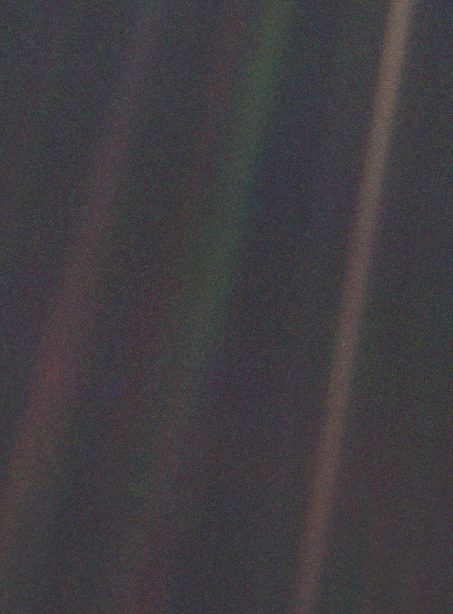
There are many fancy graphics that illustrate just how tiny we are but to me the most stunning demonstration of our place in the cosmos is called “Pale Blue Dot”, a photograph of earth taken by the Voyager 1 space probe.

Pale_Blue_Dot

If you can’t find earth at first, it is the little bright spot halfway down the right-hand sunray. Magnificent, isn’t it? The astronomer Carl Sagan once gave a speech at Cornell University about this picture that I believe should always accompany it.

We succeeded in taking that picture, and, if you look at it, you see a dot. That’s here. That’s home. That’s us. On it, everyone you ever heard of, every human being who ever lived, lived out their lives. The aggregate of all our joys and sufferings, thousands of confident religions, ideologies and economic doctrines, every hunter and forager, every hero and coward, every creator and destroyer of civilizations, every king and peasant, every young couple in love, every hopeful child, every mother and father, every inventor and explorer, every teacher of morals, every corrupt politician, every superstar, every supreme leader, every saint and sinner in the history of our species, lived there – on a mote of dust, suspended in a sunbeam.

The Earth is a very small stage in a vast cosmic arena. Think of the rivers of blood spilled by all those generals and emperors so that in glory and in triumph they could become the momentary masters of a fraction of a dot. Think of the endless cruelties visited by the inhabitants of one corner of the dot on scarcely distinguishable inhabitants of some other corner of the dot. How frequent their misunderstandings, how eager they are to kill one another, how fervent their hatreds. Our posturings, our imagined self-importance, the delusion that we have some privileged position in the universe, are challenged by this point of pale light.

[…] To my mind, there is perhaps no better demonstration of the folly of human conceits than this distant image of our tiny world.

Contemplating on this, I suppose it is hard to feel truly significant. We might as well feel high and mighty about being the rulers of a grain of sand.

However, significance is not an absolute property but a relation. Nothing is or isn’t significant, it is always significant in relation to something else. Are we significant in relation to how the Milky Way is rotating around itself over the course of 250 million years? Of course not. But why would this be the ultimate frame of reference?

If we wanted, we could go in the opposite direction. We don’t know yet what the smallest building blocks of our universe are, maybe fermions and bosons, strings and branes, quantum gravity loops or something far more exotic. But we do know that the basic structures which comprise all that exists are so minuscule that even atomic nuclei are as big to them as galactic clusters are to us. Every atom of every molecule of every substance that we consist of is as complex as an entire universe in itself.

Each of the trillions of cells that make up your body is a speck of life on its own, showing all traits that we proud ourselves on to distinguish us from the dead matter surrounding us. And all these lives form you, a life of your own, distinct yet identical to all of those beings that are created and annihilated constantly during every second of your existence.
Not only that, your body is host to an unfathomable amount of microorganisms. For all of them, you are their home, their breeding ground, their safe haven, as essential to them as the earth is to us. But they not only live off of you, they take part in and regulate processes that keep your body functioning, from your gut flora to the protective coating on your skin. Together, all of this forms a biosphere, a true superorganism, or in other words – you.

These two views do not conflict each other. We are both entirely insignificant and incredibly important, depending on what it is we are talking about. There is no need to spend time thinking about which one is more accurate, because there is no contradiction.

Instead, consider how reflecting on our place in this universe changes the way you think. You see, when I quoted Carl Sagan earlier I omitted one sentence about the Pale Blue Dot:

To me, it underscores our responsibility to deal more kindly and compassionately with one another and to preserve and cherish that pale blue dot, the only home we’ve ever known.

How about you? How did all of this make you feel? Did it inspire you to change the way you treat the ones around you?

Nothing to tea here

After I wrote my last entry while being seriously down, I thought I would write this one on a high note. While I planned this blog to be about a variety of topics I mostly wrote about depression so far but today, we are talking about tea. So if you are not interested in that, move oolong, nothing to tea here.

Did I mention I love bad puns?

Anyway, I bought some jasmine tea today. What surprised me about jasmine tea is the way it is scented. The most obvious way to add additional flavours to tea is to add more ingredients. Want some mintyness in your green tea? Add mint leaves.

However this does not work with every type of flavouring, only the ones that are water-soluble enough. Beyond that one can use essential oils, artificial substances or even smoke. Making jasmine tea however is a lot more direct. After the tea has been dried, it is mixed with freshly picked flowers either by direct blending or by spreading them out in alternating layers. At night the blossoms open and the partea is getting started.

Get it? Eh? Eh?

Since the tea is dry but the flowers are fresh, the tea absorbs the moisture and along with it the jasmine fragrance. Maybe I am just too easy to entertain but isn’t this neat? Such a low-tech solution! If well made, the result is a flavour that does not mask the taste of the base tea but rather complements it and brings you inner tranqulilitea.

Muhahaha… I’ll see myself out.

Captain Hope

My future is more uncertain than ever before. I am supposed to start a new line of work soon but time is running out and I am afraid I have myself to blame for the way it is going wrong. And even if it works out, I don’t know if I have the strength to pull it off. My family is frustrated, my meds aren’t balanced, things with my partner are not going well and life just generally sucks. I wanted to write a post entitled “Hopelessness” yesterday but it would probably just have consisted of “Yes”.

Some writers have the talent to present their readers with a new perspective on life, one that doesn’t sound like a stale pep talk but instead gives us strength to keep going, not because we fear what follows us but because we desire what lies ahead. I could try to capture this spirit but right now, my guilt makes me reject all thoughts that would lighten the burden. I really am in trouble and it is my fault. I have strategies that might make me feel less terrible but I feel like I deserve feeling terrible.

If any of you are in a similar position, remember the old saying “Depression lies”. Depression has a way of always making life appear grimmer than it is. That is very exhausting in itself, but it becomes really problematic whenever you start believing it and basing your decisions on it. Neither you nor I deserve to feel terrible. And even if you are in trouble, being miserable will not help to change that. Recalling this might not be helpful immediately, but it might help with using your own strategies, whatever they may be.

Sometimes really unexpected things help to break your negative train of thought. I tried categorizing my posts and accidentally emptied two of them. If I had deleted them, no problem, deleted posts can be restored with one click. But I somehow updated my posts to be empty and everything in it was gone. You might scold me for not having backups, but silly me believed my web hosting service would take care of that. I mean what the hell, you can update a post but you can’t revert to previous versions? That is a basic feature! And how did that happen in the first place? I never deleted anything!

At first I felt even more terrible but somehow, the anger that surfaced after I realised that my work was really gone and my host had not accounted for something like that helped me to refocus. This post was going to be really short and without any hope but now it is longer and at least a little upbeat. Even though I feel like I took a too deep of a dig into the cliché drawer.

Stigmadee, Stigmadum

Writing about the stigma attached to mental health problems is the 101 of mental health blogs, to the point that it is hard to say anything that hasn’t been said a hundred times already. While the situation is still bad, a broad front ranging from healthcare providers to patients, from relatives to celebrities is trying to raise awareness and more importantly, to educate the general public.

While this is definitely a good thing, it can sometimes lead to unintended results. I remember a conversation at a family get-together somehow shifting to a person I didn’t know and someone saying “no, she no longer has that job, she had a burnout”. With a condescending expression, one of my aunts said: “Burnout? From what?”

That was not the usual prejudice one would expect. If that conversation had taken place a few years earlier, the reaction might have been something along the lines of “oh she should just get it together”. But it wasn’t, because my aunt knew what burnout is, what causes it and that you can’t just dismiss it. And yet she managed to react in a way that makes my toenails curl up. She didn’t think bad of that person because having a burnout is a sign of weakness, she thought bad of that person because she apparently didn’t earn her burnout by hard work. The more I think about it, the more I think that this is a far worse reaction.

I am not even going to elaborate about how everyone with an illness deserves empathy, no matter how they got it. I am not going to elaborate on how what is perceived as a burden by one person is perceived differently by another.
What really grinds my gears about this is how an illness is seen as an achievement. Got burnout? Yeah that sucks, but at least it shows you are a hard worker! Well done! You got burnout? Well you don’t deserve that, you cheater!

There are just so many things wrong with that. First off, the idea itself is disgusting. It turns suffering from something that should be alleviated into a commodity that is needed to justify emotions or mental states. Secondly, this type of pressure environment is part of what drives people into burnout in the first place. Thirdly, this can lead to the idea that only people that have “earned” their suffering deserve help, treatment and empathy. And finally, this type of thinking can be expanded onto almost everything. You have depression? You never had it bad enough to warrant that! You have PTSD? What did you experience that was sooo traumatic?

We often hear complaints about how we live in a performance-based society that makes everything revolve around how much you can accomplish, that dehumanizes us by devaluating all other aspects of our individuality. But in many ways we have moved beyond that and live in a suffering-based society, where your status and your rights are dependent on how much damage you are willing to take, how much agony you are willing to put up with. This type of thinking is not just related to mental illness, this concerns everyone!

I guess I should end with some sort of solution. Well there is no simple solution to changing the ways of thinking of one person, let alone an entire society. I could end it with the old “If you want change, change yourself first” but I have an irrational aversion to these types of motto calendar catchphrases. I dunno, I guess thanks for reading and maybe thinking about it.